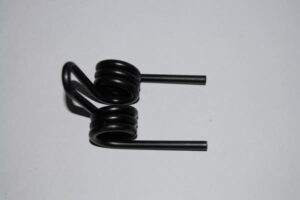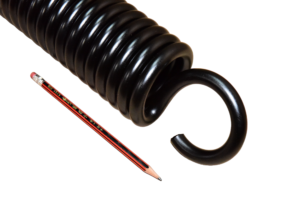
Torsion springs exert torque when twisted. They are wound with the coils close together, and the legs at each end transmit the rotational force to the assembly. Common examples include clothespins, door hinges, mousetraps and spring-loaded lids.
How a Torsion Spring Works
When the legs are rotated, the spring stores rotational energy. The main design parameters are the wire diameter, mean coil diameter, number of coils, leg lengths and the angle of deflection. Torque is proportional to the deflection angle, so the spring rate is expressed in N·mm per degree.
Leg Designs
- Straight legs – simple and low cost
- Bent legs – angled to fit the assembly
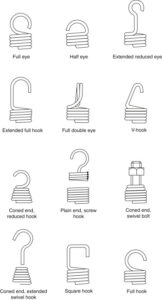
- Hinged ends – loops at the leg ends for pivoting connections
- Special forms – custom shapes produced to your drawing
Winding Direction
Left-hand or right-hand winding depends on the direction of the applied torque. It is easy to get this wrong, so specify it on the drawing or ask the manufacturer to confirm it from the application.
Materials and Standards
Torsion springs are commonly made from EN 10270-1 spring steel, EN 10270-2 oil tempered wire or EN 10270-3 stainless steel. For European projects, leg forms can be manufactured to DIN 2088 and finishes can be supplied RoHS/REACH compliant.
What to Send for a Quote
Provide the wire diameter, mean coil diameter, number of coils, leg lengths and positions, the required torque at a given angle, and the winding direction. A drawing or STEP file is ideal. Send your requirement to our engineers for a free design review.