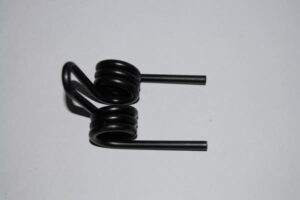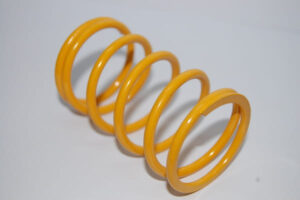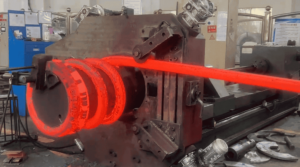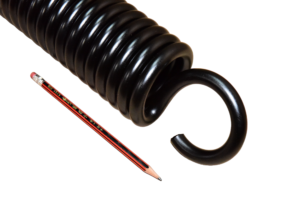
Tension springs, also called extension springs, absorb and store energy by resisting pulling forces. Their end hooks are an essential part of the design because they connect the spring to the rest of the assembly and influence the load path.
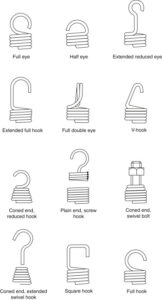
Common Hook Types
- Full loops – the standard closed end, suitable for most applications
- Extended loops – a longer loop that makes assembly easier and reduces stress concentration at the transition
- Double torsion loops (crossover ends) – both ends point the same way, saving space in compact designs
- Side loops – loops positioned at an angle to the spring body
- Special hooks – threaded inserts, V-hooks and custom forms for specific assemblies
Initial Tension Matters
Tension springs are wound so that the coils touch each other. The force holding them together is called initial tension. It must be specified because it affects the spring rate and the load at a given length:
Rate = (Load – Initial Tension) / Travel
If initial tension is not controlled, spring force can vary noticeably between batches.
How to Specify a Tension Spring
- Wire diameter and material (EN 10270-1, EN 10270-2 or EN 10270-3)
- Outside diameter and body length
- Hook type and hook dimensions (loop inside diameter, leg length)
- Initial tension, spring rate and working travel
- Winding direction if the assembly requires it
- Surface treatment and compliance (RoHS/REACH, certificates)
Applications
Tension springs are used in garage doors, trampolines, agricultural equipment, washing machines, toys, brakes and countless mechanical assemblies.
If you need help choosing a hook type or calculating spring rate, send your drawing to EASON SPRING engineers and we will confirm the design and provide a quotation.