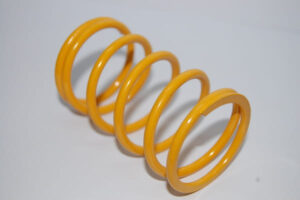
Compression springs are the most common type of industrial spring. They resist axial compression and store mechanical energy. This guide explains the parameters engineers need to specify, and the mistakes to avoid when ordering.
Key Dimensions of a Compression Spring
- Wire diameter (d) – the thickness of the wire
- Outside diameter (OD) or inside diameter (ID) – depending on whether the spring fits in a bore or over a rod
- Free length (L0) – the length of the unloaded spring
- Solid height (Lc) – the length when all coils are touching
- Number of active coils (n) – coils that actually deflect
- Spring rate (R) – force per unit of deflection, e.g. N/mm
End Types
The ends of a compression spring affect seating and stability:
- Closed ends – standard for most applications
- Closed and ground ends – for precise seating and reduced buckling
- Open ends – where cost matters and load accuracy is less critical
Choosing the Material
For general industrial use, EN 10270-1 spring steel offers high strength at low cost. EN 10270-2 oil tempered wire suits heavy-duty or fatigue-loaded springs. EN 10270-3 stainless steel (AISI 302/304/316) is used where corrosion resistance, food contact or medical applications require it.
Common Mistakes When Ordering
- Giving only the outside diameter and free length, without wire diameter or rate
- Not specifying whether the spring works in a bore or over a rod (which affects OD/ID tolerances)
- Ignoring maximum deflection and solid height, causing coil binding
- Forgetting surface treatment for corrosive environments
How to Order
Send a drawing, a 3D file (STEP/IGES), or the key dimensions listed above together with your quantity and finish requirements. For European projects, also confirm material standards (EN 10270), tolerances (DIN 2095) and compliance needs such as RoHS/REACH and EN 10204 3.1 certificates. Contact our engineers for a quotation or design review.